


VGhlcmUgaXMgbm8gZ2VudWluZSBpbnRlbGxpZ2VuY2UgLCB0aGVyZSBpcyBhcnRpZmljaWFsIHN0dXBpZGl0eS4NClRoZXJlIGlzIG5vIHNlcmVuaXR5LCB0aGVyZSBpcyBhbnhpZXR5Lg0KVGhlcmUgaXMgbm8gcGVhY2UsIHRoZXJlIGlzIHR1cm1vaWwuDQpUaGVyZSBpcyBubyBzdHJ1Y3R1cmUsIHRoZXJlIGlzIHBvcnJpZGdlLg0KVGhlcmUgaXMgbm8gb3JkZXIsIHRoZXJlIGlzIGNoYW9zLg==

  • 1 Post
  • 59 Comments
Joined 2 years ago
cake
Cake day: May 14th, 2024

help-circle

  • With Linux related issues, it’s usually a good idea to include the name of the distro.

    For example: debian apt unmet dependencies

    or even: arch wiki nvidia

    When looking for information about a particular rock, add the word “mineral” in the search query. If you forget to add it, you’ll usually end up reading about some mystical and magical properties you can still probably include in your next D&D campaign. If you’re feeling extra technical, try adding mindat or webmineral

    Example: Chrysocolla mineral

    Technical: Chrysocolla webmineral


  • Here’s a more nuanced approach. Once this messages is posted, it’s public. during the same day, it will be copied to a bunch of servers across the fediverse. It’s easily available to everyone who cares to look for it. After a few decades, most copies of the message will be gone, but maybe one or two will still remain tucked away somewhere. It’s still technically public, but it’s getting a bit rare. That’s ok though, because nobody cares about 30 year old online ramblings written on some archaic social media that got replaced by the New Cool Thing.

    After a hundred years or so, it’s highly likely that almost every record of this conversation is permanently gone. Maybe there’s a data historian who has a personal copy of the entire fediverse. What if that one historian forgets that their Crystalline Omni-Relational Uni-Protonic Tachyon storage, containing the only copy, was in the pocket of the trousers that went into the washing machine? When they hear the spaceship keys clanging inside the washing machine, they stop the cycle, but by that point, the ‘original manuscript’ is already gone. All you have left are some references, summaries, interpretations, translations etc. Nobody knows what the original actually said, but historians just love to debate and speculate about it anyway.


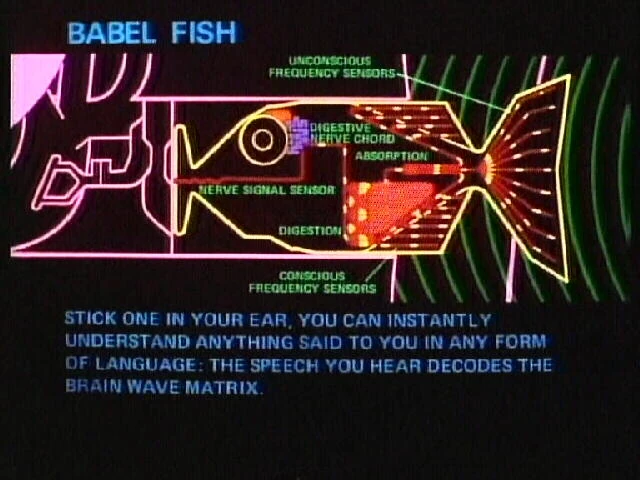
  • Maybe in the future you could have an AI implant to take care of all translations while you’re talking to people, and this idea has been explored in scifi many times. I think the babel fish was the funniest way to implement this idea in a story.

    If that sort of translator becomes widespread, it would definitely change the status learning languages has. That would also mean you have to think about a potential man in the middle attack. Can you trust the corporation that runs the AI? What if you want to have a discussion about a topic that isn’t approved by your local tyrannical dictatorship? MITM attack can become a serious concern. Most people probably don’t care that much, so they won’t learn new languages, but some people really need to.


  • The Last Airbender.

    If you just forget about the avatar series for a while, and treat this as a bit of harmless fun, it’s not that bad. Well it’s not good enough that I would watch it again, nor is it bad enough to warrant all the abysmal reviews. If you expect this movie to fit in with the series, all of the hate and anger is entirely justified though.

    It all depends on how you watch this movie, and I would argue that there is a way to enjoy it. It’s not all bad.


  • That’s a problem when you want to automate the curation and annotation process. So far, you could have just dumped all of your data into the model, but that might not be an option in the future, as more and more of the training data was generated by other LLMs.

    When that approach stops working, AI companies need to figure out a way to get high quality data, and that’s when it becomes useful to have data that was verified to be written by actual people. This way, an AI doesn’t even need to be able to curate the data, as humans have done that to some extent. You could just prioritize the small amount of verified data while still using the vast amounts of unverified data for training.


  • Math problems are a unique challenge for LLMs, often resulting in bizarre mistakes. While an LLM can look up formulas and constants, it usually struggles with applying them correctly. Sort of, like counting the hours in a week, it says it calculates 7*24, which looks good, but somehow the answer is still 10 🤯. Like, WTF? How did that happen? In reality, that specific problem might not be that hard, but the same phenomenon can still be seen in more complicated problems. I could give some other examples too, but this post is long enough as it is.

    For reliable results in math-related queries, I find it best to ask the LLM for formulas and values, then perform the calculations myself. The LLM can typically look up information reasonably accurately but will mess up the application. Just use the right tool for the right job, and you’ll be ok.